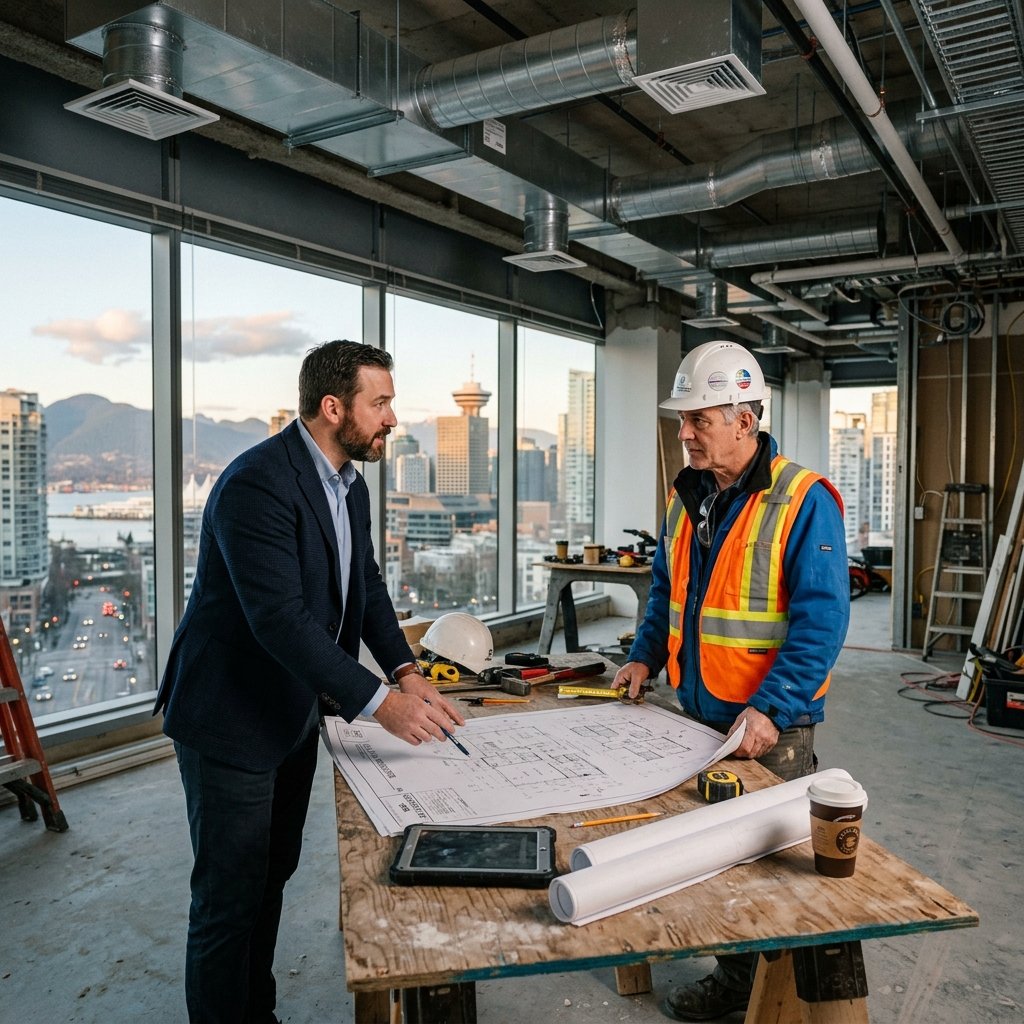
- BC's 2025 Business Practices and Consumer Protection Act amendments now void any contract clause that blocks you from class proceedings or forces arbitration on commercial claims under $5,000.
- Vancouver commercial contractors must hold a City of Vancouver General Contractor licence, an active WorkSafeBC clearance letter, and Technical Safety BC trade certifications for gas and electrical work.
- $100,000 covers roughly 550 square feet of mid-range commercial fit-out in Vancouver at $180 per square foot. Anything bigger than that means cosmetic work only.
- Mechanical, electrical, and plumbing systems eat 40 to 50 per cent of every commercial renovation budget. This is where most rip-offs hide.
- Never disclose your maximum budget upfront, never accept cash-only deals, and never agree to skip permits. These are the three fastest ways to get burned in BC.
- The 2024 BC Building Code seismic requirements take effect September 15, 2026. Any contractor who doesn't mention engineered shop drawings for HVAC and heavy piping is already behind.
At DELANA Interiors, we've been building and renovating commercial spaces in Metro Vancouver for over forty years. In that time I've watched good business owners lose six figures to contractors who knew exactly how to play the system. I've also been called in to fix half-finished projects after the original contractor disappeared with a deposit. What follows is everything I tell new commercial clients before they sign anything.
This is for business owners about to spend $50,000 to $500,000 on an office, retail, restaurant, or medical clinic fit-out in Vancouver. If that's you, read this twice.
How can a Vancouver business owner avoid getting ripped off by a commercial contractor?
The single best protection is verifying credentials before signing and using BC's updated 2025 consumer protection laws to your advantage. Hire only contractors with a valid City of Vancouver General Contractor licence, active WorkSafeBC clearance, and Technical Safety BC certifications for any gas or electrical work. Get three written quotes minimum, never agree to a verbal contract, and never pay more than 10 per cent up front.
Here's the part most business owners don't know. As of March 31, 2025, BC's Business Practices and Consumer Protection Act was amended to make several types of contract clauses legally void. Any clause that prevents you from joining a class proceeding is now unenforceable. Any clause forcing private arbitration on a claim under $5,000 is also unenforceable. If your contractor's contract has either of these, the clause means nothing in court.
The other protection is your payment schedule. Use progress draws minus a 10 per cent holdback. That means you pay for the value of materials on-site and work completed at each milestone, but always hold back 10 per cent until everything is finished and inspected. Contractors who refuse this structure are telling you something important. Listen.
Verify the contractor's licence, WorkSafeBC clearance, and proof of liability insurance before the deposit cheque is written. RenoMark-certified contractors carry a minimum $2 million in liability coverage, which is a reasonable benchmark for any commercial job in Vancouver. If a contractor cannot produce these documents in 24 hours, they don't have them.
Also check Consumer Protection BC. They keep a public record of compliance orders and administrative penalties issued against contractors. A clean record is the bare minimum.
For most business owners I work with, the right move is to hire a commercial renovation contractor in Vancouver who handles permits, inspections, and trades under one written contract. One throat to choke. No subcontractor disputes. No mystery line items at the end.
What are the most common commercial contractor mistakes that cost businesses money?
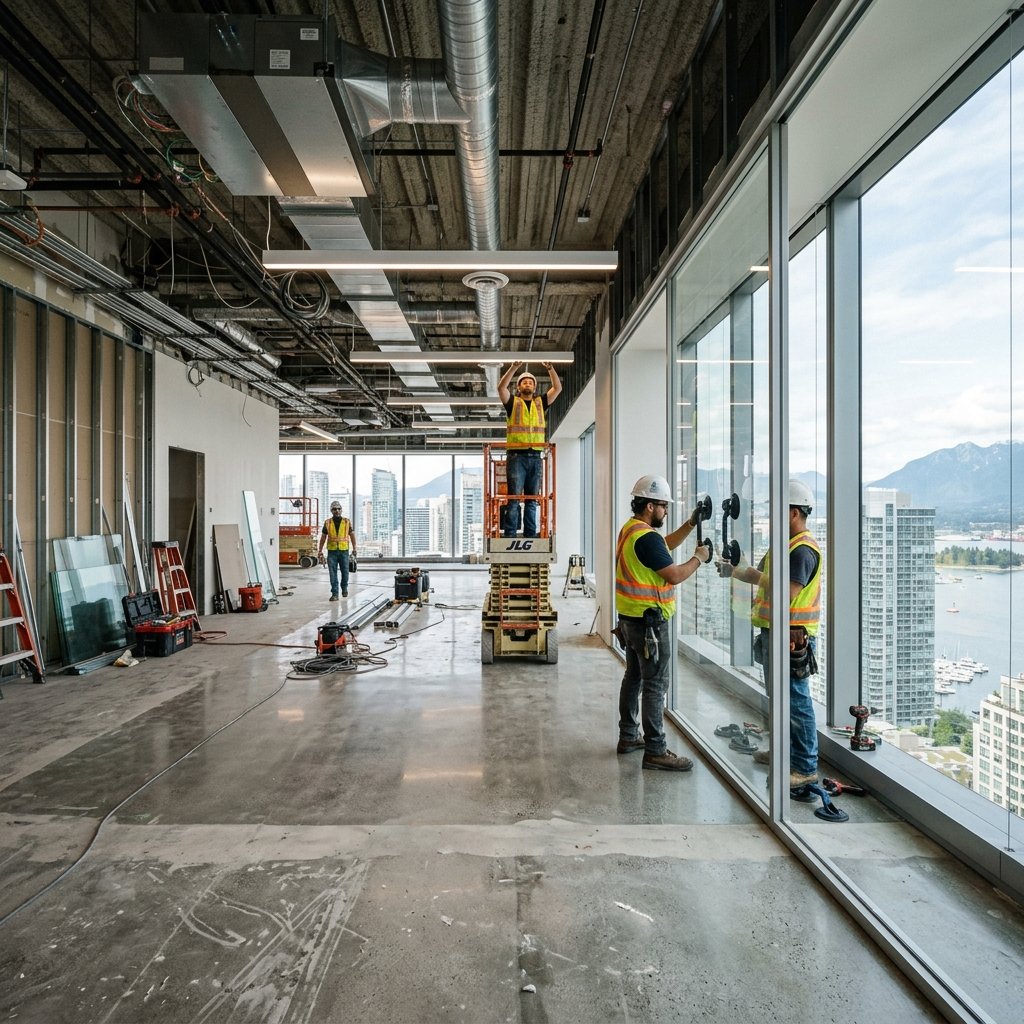
The most expensive mistakes are skipping mechanical and electrical planning early, missing permits, and letting scope creep happen without written change orders. These three errors account for the majority of cost blowouts I've seen on Vancouver commercial projects in the past decade.
Start with mechanical, electrical, and plumbing, or what we call MEP. These systems can account for 40 to 50 per cent of a commercial fit-out budget. When a contractor skips MEP planning during the design phase, problems show up during construction. Walls have to come down. Ceiling heights change. HVAC zones get redrawn. Each of those changes is a new line item on your invoice.
The second mistake is permit avoidance. Contractors who tell you "we don't need a permit for this" are protecting their margin, not your business. Skipping permits triggers safety authority investigations, fines, and forced rework. Worse, it can void your business insurance the moment something goes wrong. A fire or structural failure on unpermitted work means you're paying out of pocket.
There is also a 2026 deadline every Vancouver business owner needs to know about. The 2024 BC Building Code introduces new seismic requirements effective September 15, 2026. These mandate engineered shop drawings for non-structural components like HVAC ducts and heavy piping. If your contractor isn't mentioning this on a project that will finish after that date, they're either out of touch or hoping you won't notice the cost overrun later.
The third mistake is the builder's lien problem. If your general contractor doesn't pay their subcontractors or material suppliers, those unpaid trades have legal protections in BC that allow them to register a lien against your property. You can be forced to pay twice, once to your GC, and again to settle the lien. The protection here is your 10 per cent holdback, plus a clean payment schedule that includes proof of payment to subs at each draw. I ask for those receipts. Every project. No exceptions.
Scope creep is the fourth and quietest mistake. Every change to the original scope of work needs a written change order with a fixed price before the work starts. Verbal "while you're at it" requests turn into the biggest line items on the final invoice.
What should you never tell or say to a commercial contractor?
Never reveal your maximum budget, never agree to a cash-only deal, never say you don't need a permit, and never tell a contractor you're in a rush. Each of these gives away leverage that costs you money.
Here's why.
"My maximum budget is $X." Once a contractor knows your ceiling, every quote you receive will land near that ceiling. This is called budget matching. You've just told them how much you'll pay, so why would they bid lower? The right move is to share the project scope, ask for itemised quotes, and let the market price the work honestly.
"I'll pay you in cash for a discount." Cash deals are how fraud happens. No written contract, no warranty, no recourse if the work is bad. You also have no proof of payment if a builder's lien gets filed against your property. Renomark and the Canadian Home Builders' Association both warn that cash-only contractors should be treated as a red flag, not a deal.
"I don't need a permit for this part." This sentence removes your legal protection. If a fire or structural failure happens on unpermitted work, your business insurance can refuse to pay out. The City of Vancouver actively investigates unpermitted commercial work, and the fines plus mandatory corrections cost more than the permit ever would have.
"I'm in a rush. When can you start?" Expressing urgency invites contractors to add expediting fees, weekend overtime, and rush-order material premiums. Even if you genuinely are in a rush, never say so during the quoting phase. Get the quotes first based on a normal timeline, then negotiate a faster schedule afterward.
There's one more line that's worth adding to this list. "This is my first commercial renovation." Saying this tells a contractor you don't know what questions to ask. Instead, walk into the meeting with a written scope of work, a list of must-have inclusions, and questions about their licensing and insurance. Even if it's your first project, you don't have to look like it.

How much commercial renovation can you actually get done with a $100,000 budget in Vancouver?
A $100,000 budget in Vancouver covers roughly 550 square feet of mid-range commercial fit-out at the 2025 to 2026 average of $180 per square foot. For larger spaces, $100,000 only buys a cosmetic refresh: paint, flooring, light fixtures, and minor partition changes.
Vancouver commercial pricing has climbed every year since 2022, and 2025 has been the worst yet for material and labour costs. Published 2025 to 2026 Vancouver commercial contractor pricing breaks down like this.
Vancouver Commercial Renovation Cost Per Square Foot (2025–2026)
| Project Type | Per Sq Ft (Low) | Per Sq Ft (High) | What's Included |
|---|---|---|---|
| Basic office fit-out | $80 | $150 | Paint, flooring, basic lighting, minor partitions, no MEP changes |
| Mid-range office | $150 | $250 | New layout, glass partitions, upgraded lighting, partial HVAC work, custom millwork |
| Retail or restaurant shell | $200 | $400 | Storefront, full electrical, basic kitchen rough-in, signage, customer-facing finishes |
| Medical or dental clinic | $300 | $500 | Specialty plumbing, lead-lined walls where needed, full HVAC zoning, regulated finishes |
Where does your $100,000 actually go? Here's the typical trade breakdown for a mid-range Vancouver office fit-out at this budget level.
- Electrical and lighting: $20,000 to $30,000. This covers LED fixtures, power outlets, data cabling, and panel upgrades.
- Partitions and drywall: $15,000 to $25,000. Standard drywall runs $8 to $15 per square foot. Glass partitions are significantly more.
- Flooring and finishes: $15,000 to $20,000. Vinyl plank or carpet tile runs $5 to $12 per square foot.
- Permits and fees: $5,000 to $10,000. City of Vancouver building, electrical, and plumbing permits combined.
- Demolition and prep: $5,000 to $8,000. Removal of existing finishes, partitions, and old fixtures.
- HVAC modifications: $10,000 to $20,000 if any zone changes are required.
- General contractor management and contingency: $10,000 to $15,000 across the project.
Look at what's missing from a $100,000 budget. Custom millwork, structural changes, seismic upgrades, kitchen equipment, and high-end finishes are not in this number. If your project needs any of those, the realistic budget jumps to $150,000 to $250,000 minimum. I tell business owners this on the first call so nobody walks in thinking $100K buys a full restaurant fit-out. It does not.
What is the most expensive part of a commercial renovation, and where can you cut without losing quality?
The most expensive component of a Vancouver commercial renovation is the mechanical, electrical, and plumbing (MEP) system, which consistently consumes 40 to 50 per cent of the total budget. The smartest place to save money is in space planning, finish allocation, and trade scheduling. Not in cutting permits, inspections, or BC Building Code compliance.
Here's where the money actually goes on a typical commercial fit-out, ranked from most expensive to least.
- MEP systems (40–50%) — HVAC, electrical, plumbing, fire suppression
- Partitions, drywall, ceilings (15–20%)
- Custom millwork and built-ins (10–15%) — only if specified
- Flooring and finishes (10–12%)
- Permits, inspections, and management (8–12%)
- Demolition and prep (5–8%)
Now the cuts. These are the moves I recommend to commercial clients who need to bring their budget down without compromising the project.
Open-plan layouts beat private offices. Every interior wall adds drywall, electrical switching, HVAC zoning, and door hardware. Reducing wall count by even 30 per cent can meaningfully cut MEP costs without affecting the function of the space.
Use high-end finishes only in client-facing areas. Reception, meeting rooms, and customer-visible zones get the premium materials. Staff-only back-office areas use durable mid-range finishes. The visual impact lands where it matters and the budget stretches further.
Consolidate trades. A general contractor in Vancouver who manages all trades under one contract typically saves 8 to 15 per cent compared to hiring trades separately. Coordination is built into one schedule. Subcontractor disputes are absorbed by the GC, not by you.
Phase the project. If your business can stay open during construction, phasing the work in sections cuts the need for off-hours premium labour and extended temporary measures.
What you should never cut: building permits, third-party warranties, BC Building Code compliance, WorkSafeBC coverage, and the 10 per cent holdback. These cost a small fraction of the total budget and protect everything else.
If you're planning a tenant improvement project in Vancouver, the same rules apply with one addition. Read your lease agreement carefully and confirm what your landlord is responsible for versus what falls on you. I have seen this go sideways more than once.
Frequently Asked Questions About Commercial Renovation in Vancouver
Do you need a licence to do commercial renovations in BC?
Yes, every commercial general contractor in BC needs a valid municipal business licence, WorkSafeBC registration, and Technical Safety BC certifications for gas and electrical work. Every commercial general contractor in BC needs a valid municipal business licence from each city where they work. In Vancouver, that means a City of Vancouver General Contractor licence. Contractors must also register with WorkSafeBC for workers' compensation coverage. Specialty trades like gas fitting and electrical work require Technical Safety BC certifications. Always ask for proof of all three before signing.
What are the three types of commercial renovation?
Commercial renovations in BC are typically grouped into three tiers: cosmetic refresh, mid-range fit-out, and full buildout. A cosmetic refresh covers paint, flooring, light fixtures, and minor partition changes. A mid-range fit-out includes layout changes, glass partitions, upgraded lighting, and partial HVAC modifications. A full buildout is everything from demolition through new MEP systems, custom millwork, and final inspections. Each tier has its own permit requirements and per-square-foot cost range.
What are the four types of remodelling, and which applies to a commercial space?
The four practical categories for commercial properties are code-compliance updates, brand and customer-experience refreshes, productivity-driven layout changes, and structural or expansion work. Code-compliance updates bring older spaces up to current building code. Brand and customer-experience refreshes are visual upgrades for retail and hospitality. Productivity-driven layout changes are office reconfigurations. Structural or expansion work covers load-bearing changes and additions. Most Vancouver commercial projects fall into the second or third category.
How much do commercial contractors charge per hour in Canada?
Skilled trades in Metro Vancouver typically bill at $85 to $180 per hour, though most commercial renovations are quoted as fixed-price contracts based on square footage. Statistics Canada reported the average construction industry wage at $37.86 per hour in 2025, but that's the labour cost, not the billing rate. Project managers and senior trades can bill higher on complex commercial work. Most commercial renovations are quoted as fixed-price contracts based on square footage, not hourly rates, which is why a written scope of work matters so much.
Get a Free Written Quote for Your Vancouver Commercial Renovation
Jim Lazos and the DELANA Interiors team have been building and renovating commercial spaces across Metro Vancouver since 1981. Office, retail, restaurant, and medical clinic fit-outs — all under one written contract, with full City of Vancouver, WorkSafeBC, and Technical Safety BC credentials in hand before any deposit is requested.
When you're ready to talk through your commercial project, give us a call. We'll walk you through scope, permits, and what's realistic for Vancouver in 2026 — no pressure, no surprises.
(236) 858-8187
Monday – Friday, 7:00 AM – 6:00 PM
delanainteriors.ca
Service areas: Vancouver · West Vancouver · North Vancouver · Burnaby · Shaughnessy · Richmond
Related Reading from DELANA Interiors
Talk to DELANA Interiors About Your Commercial Project
DELANA Interiors has been building and renovating commercial spaces in Metro Vancouver for over 40 years. We hold all required City of Vancouver, WorkSafeBC, and Technical Safety BC credentials, and put every commercial project in writing before any deposit is requested. Office, retail, restaurant, and medical clinic fit-outs across West Vancouver, North Vancouver, Burnaby, and Vancouver. Call us at (236) 858-8187 for a free consultation.